Key Takeaways
- Delaware commercial properties that finalize holiday lighting contracts by September avoid scheduling conflicts and material shortages that hit later bookers hard.
- Window frame C9 outlines, canopy garland runs, and entrance wreath installations are the three highest-impact storefront display upgrades for Fall 2026.
- Warm white and multicolor C9 bulbs serve different brand personalities — choose intentionally to match your retail identity.
- ADA path-of-travel rules and Delaware municipal display ordinances affect how and where lighting fixtures can be mounted, especially in Main Street districts and shopping centers.
- Bundling installation, takedown, and storage into a single seasonal contract is the most cost-efficient approach for multi-unit commercial properties.
Walk any Delaware Main Street in mid-November and you will notice which storefronts planned ahead and which ones scrambled. The properties with crisp warm-white C9 outlines tracing their window frames, lush fresh-cut garland draping their canopies, and full wreaths flanking their entrance doors did not pull that off in October. They made those decisions in August and signed contracts in September. The storefronts with a single strand of leftover lights taped above the door? Different story. If you manage a commercial property in Delaware — a boutique on a downtown corridor, a strip center on a Route 1 commercial stretch, or a mixed-use development near the coast — this guide is your actionable roadmap for Fall 2026.
Why September Is the Hard Deadline for Delaware Commercial Lighting Contracts
September 1 is effectively the last safe date for Delaware commercial clients to finalize holiday lighting contracts without risking compromised crew availability, limited product selection, or rushed installations. Professional lighting crews in Delaware book sequentially: municipal accounts lock in first (often in late spring), large commercial properties follow in June and July, and the remaining calendar fills through August. By early October, experienced installation teams are committed for the season.
The math is straightforward. A crew that services 40 commercial accounts between mid-November and December 15 has a finite number of installation days. Delaware's shoulder-season weather — particularly the nor'easters and coastal wind events that arrive in November — routinely wipe out two to four installation days per month. Crews build buffer into their calendars for exactly that reason, which means available slots disappear faster than the raw number of accounts suggests.
Material availability compounds the crew constraint. Commercial-grade C9 bulbs in warm white and multicolor, commercial-length garland runs (typically sold in 9-foot and 25-foot segments), and oversized wreaths sized for commercial entrances (24-inch to 48-inch diameters) sell through wholesale channels months before retail demand peaks. Clients who finalize contracts in September allow their lighting provider to reserve product at current pricing. Those who call in October often face substitutions or upcharges.
We covered the broader case for early booking in our post on Christmas in July early booking for Delaware holiday lights — the same logic applies with even greater urgency for commercial properties, which require more crew time, more product, and more coordination than a typical residential job. For a deeper look at building a realistic budget before your September deadline, read our holiday lighting budget planning guide for Delaware.
Storefront Display Options: What Works for Delaware Commercial Properties
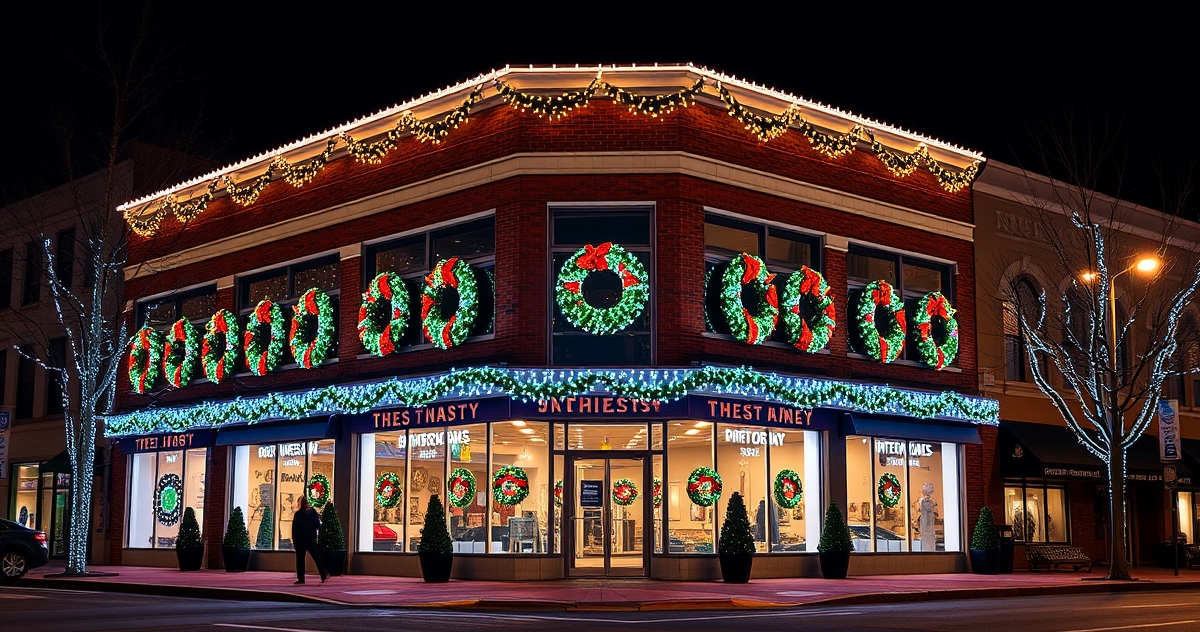
Three installation formats consistently deliver the strongest visual return for Delaware storefronts: window frame C9 outlines, canopy garland runs, and entrance wreath installations. Each addresses a different part of the customer's first impression, and together they create a layered display that reads as intentional rather than afterthought.
Window Frame C9 Outlines
C9 bulbs — the larger, faceted commercial-grade bulbs spaced roughly 12 inches apart on heavy-duty cords — are the workhorse of professional storefront lighting. Mounted along the exterior perimeter of display windows, they define the architecture of your storefront with a clean, graphic line that reads from a distance and from a moving vehicle.
Warm white C9s project a classic, upscale character that suits jewelry stores, home goods boutiques, restaurants, and professional service offices. Multicolor C9s (traditional red, green, blue, yellow, and orange) carry a festive, family-friendly energy that works well for toy stores, candy shops, family restaurants, and community-focused retailers. Neither is inherently better — the right choice depends on your brand and your customer base.
For a standard 36-inch by 60-inch commercial window, a full perimeter outline requires approximately 16 linear feet of C9 cord. Multi-window storefronts with consistent window sizing benefit from modular setups that allow crews to replicate the same look across every bay, which also simplifies end-of-season removal. See our commercial lighting services page for the full scope of what's available for retail and mixed-use properties.
Canopy Garland Runs
Fabric or mixed-pine garland draped along a storefront canopy or awning valance adds texture and dimension that string lights alone cannot achieve. Commercial garland is sold in pre-lit and unlit versions; pre-lit garland with integrated warm-white or multicolor miniature lights is the more popular choice for storefronts because it eliminates the need for a separate lighting layer and creates a cohesive look.
A standard 9-foot canopy run uses one 9-foot garland segment. Wider canopies — common in Delaware strip centers with 20-foot to 30-foot bays — require ganged segments connected with weatherproof connectors. Installation crews use stainless-steel S-hooks or UV-resistant zip ties rated for outdoor use; adhesive hooks are not appropriate for commercial applications and violate most commercial lease agreements' exterior modification clauses.
Delaware's coastal and bay-adjacent properties should specify garland products rated for salt-air exposure. Standard indoor-grade garland degrades rapidly in the humidity and salt content typical of Sussex and Kent County commercial corridors near the water. Our team always accounts for coastal conditions — something we discuss in depth in our guide to outdoor Christmas lights and Delaware coastal weather.
Entrance Wreath Installations
A commercial entrance wreath mounted above or flanking the primary door is the single most photographed element of a holiday storefront display. For commercial applications, wreaths sized at 30 inches to 48 inches in diameter are standard; anything smaller reads as residential and undersized against a commercial door frame. Pre-lit wreaths with warm-white or multicolor integrated lights are the most popular option, though unlit wreaths with decorative bows in brand colors are gaining traction among boutique retailers who want a more curated, non-electrified look.
Mounting hardware matters at the commercial scale. Heavy wreaths (those exceeding 8 pounds) require load-rated hooks anchored into the door frame or adjacent masonry — not adhesive strips. Crews installing wreaths on historic Main Street buildings in towns like Lewes, Milford, or Middletown should confirm with building management that any penetration or surface mount complies with historic preservation guidelines that some Delaware municipalities enforce on their commercial corridors.
Mixing Warm White and Multicolor: A Visual Strategy for Retail Corridors
Delaware's commercial corridors look best when individual storefronts make a deliberate color choice rather than defaulting to whatever was available. Warm white is the dominant color in upscale retail and restaurant districts; multicolor performs better in family-oriented and entertainment retail environments. A practical rule: if your brand uses a defined color palette in its signage and marketing, let that guide your lighting color selection.
| Display Element | Warm White Effect | Multicolor Effect | Best Fit |
|---|---|---|---|
| C9 Window Outlines | Elegant, architectural, upscale | Festive, playful, high-energy | Warm white for boutiques; multicolor for family retail |
| Canopy Garland | Soft glow, inviting, classic | Bold, eye-catching, celebratory | Warm white for restaurants; multicolor for toy/gift stores |
| Entrance Wreaths | Refined, traditional | Bright, welcoming to families | Either works — match to window outlines for cohesion |
| Tree Lighting (lobby/courtyard) | Sophisticated ambiance | Seasonal excitement | Warm white for mixed-use; multicolor for outdoor plazas |
Shopping centers with multiple tenants should consider establishing a property-wide color standard in their holiday lighting guidelines. A center where half the tenants use warm white and half use multicolor can look chaotic from the parking lot. A coordinated warm-white canopy garland at the property level, with individual tenants free to add multicolor accents in their windows, is one effective compromise. Our commercial services team regularly works with property managers on exactly this kind of multi-tenant coordination.
ADA Compliance and Municipal Display Ordinances in Delaware
ADA path-of-travel requirements and local display ordinances are the two regulatory areas that most commonly catch Delaware commercial property owners off guard during holiday lighting installations. Understanding both before your September contract date prevents costly corrections and potential citations.
ADA Path-of-Travel Considerations
The Americans with Disabilities Act requires that accessible routes to commercial entrances remain unobstructed at all times. Holiday lighting installations that introduce ground-level cords, extension cables routed across walkways, or overhanging elements below 80 inches in a path of travel create ADA violations. Best practices include:
- Routing all power cords overhead or through conduit chases rather than across pedestrian surfaces.
- Confirming that any ground-mounted display elements (potted trees, illuminated figures) are positioned outside the 44-inch minimum clear width of accessible routes.
- Ensuring that entrance wreath hardware does not reduce the clear opening width of accessible doors.
- Using UL-listed weatherproof connectors and GFCI-protected circuits for all exterior installations — required by the NEC and enforced by Delaware's State Fire Marshal's office.
Delaware Municipal Display Ordinances
Delaware's incorporated towns and cities vary in how specifically they regulate commercial holiday displays. Several Main Street districts — governed by active Main Street Delaware program participation — have display guidelines that address lighting color, mounting methods, and illumination hours. Shopping centers subject to Planned Unit Development (PUD) approvals may have exterior appearance standards baked into their site plan approvals that restrict signage and decorative lighting.
Specific considerations for Delaware commercial operators include:
- Illumination curfews: Some Delaware municipalities limit exterior commercial lighting to specific hours (commonly 11 PM or midnight shutoff). Timer-controlled circuits are the simplest compliance solution and also reduce energy costs.
- Sign permit crossover: Illuminated displays that incorporate letters, numbers, or logos may be classified as signage under local zoning codes and require a sign permit in addition to any standard electrical permit.
- Historic district review: Storefronts in Delaware's historic commercial districts may require approval from a local historic preservation commission before any exterior mounting hardware is installed.
- Right-of-way encroachment: Displays that extend over a public sidewalk — including overhanging garland or suspended lights — typically require an encroachment permit from the municipal public works department.
Your lighting contractor should be familiar with the specific regulations governing your municipality. Always pull required permits before installation begins, and keep permit documentation on file through the end of the season.
Bundling Services: Installation, Removal, and Storage
The most cost-efficient approach for Delaware commercial clients is to contract for installation, post-season removal, and off-site storage as a single bundled service. This eliminates the risk of displays remaining up past municipal deadlines (some Delaware towns enforce January 15 removal requirements for commercial properties), protects commercial-grade inventory from damage during on-site storage in unconditioned spaces, and ensures that product is inspected and ready for reinstallation the following fall.
For properties investing in permanent or semi-permanent display infrastructure — such as C9 cord runs hard-mounted to window frames or fixed garland hooks on canopy fascia — our permanent lighting installations and removal and storage services provide a seamless year-round solution. Learn more about comprehensive planning at our professional holiday lighting installation planning guide.
Frequently Asked Questions
When should a Delaware commercial property finalize its holiday lighting contract for Fall 2026?
Delaware commercial properties should finalize holiday lighting contracts by September 1, 2026. Professional installation crews in Delaware fill their commercial calendars sequentially starting in spring, and by early October most experienced teams are fully committed for the season. September contracts also allow your provider to reserve commercial-grade C9 bulbs, garland, and wreaths at current pricing before wholesale inventory sells through.
What are the most effective storefront lighting options for Delaware retail businesses?
The three highest-impact storefront display upgrades for Delaware retail businesses are window frame C9 outlines, canopy garland runs, and entrance wreath installations. Window C9 outlines in warm white or multicolor define your architecture from a distance. Canopy garland adds texture and dimension. Entrance wreaths sized at 30 to 48 inches create a welcoming focal point at the point of entry. Used together, these three elements create a layered, professional display that reads as intentional from the parking lot and from passing traffic.
Do Delaware storefronts need permits for holiday lighting installations?
Permit requirements vary by municipality in Delaware. Illuminated displays that incorporate logos or text may be classified as signage and require a sign permit. Displays that overhang a public sidewalk typically require a right-of-way encroachment permit from the local public works department. Storefronts in historic commercial districts may need approval from a local preservation commission before any mounting hardware is installed. All exterior electrical work must comply with NEC requirements and Delaware State Fire Marshal standards, which typically means GFCI-protected circuits and UL-listed weatherproof connectors.
How do ADA requirements affect commercial holiday lighting installations?
ADA requirements prohibit holiday lighting installations from obstructing accessible routes to commercial entrances. Ground-level cords routed across pedestrian paths, overhanging elements below 80 inches in a path of travel, and display elements that reduce the clear width of accessible routes all create violations. Professional installation crews route power cords overhead or through conduit, position ground-mounted elements outside the minimum 44-inch accessible route clear width, and confirm that entrance wreath hardware does not reduce accessible door opening dimensions.
Should Delaware commercial storefronts use warm white or multicolor lights?
The choice between warm white and multicolor should reflect your brand identity and customer base. Warm white C9 bulbs project an elegant, upscale character suited to boutiques, restaurants, and professional service businesses. Multicolor C9s carry a festive, family-friendly energy that works well for toy stores, candy shops, and family-oriented retailers. For multi-tenant properties, establishing a property-wide color standard — such as warm white for canopy garland with tenant-level flexibility for window accents — creates visual cohesion across the shopping center.
What is included in a commercial holiday lighting removal and storage contract?
A commercial removal and storage contract typically covers post-season disassembly of all installed lighting elements, inspection of C9 cords, garland, wreaths, and mounting hardware for damage or wear, secure off-site storage in a climate-controlled facility, and delivery or reinstallation the following fall season. Bundling removal and storage with installation is the most cost-efficient approach for commercial clients and ensures displays come down before municipal removal deadlines — commonly January 15 in Delaware's incorporated municipalities.
Ready to lock in your Fall 2026 storefront display before the September deadline? Contact Holiday Lights Decor Delaware for a free commercial estimate and let's build a lighting plan that reflects your brand, meets local requirements, and turns heads all season long.