Key Takeaways
- Summer — especially June and July — is the smartest time for Delaware homeowners to book holiday lighting installations and secure early-season pricing before fall demand spikes.
- Choosing energy-efficient LED C9 bulbs over traditional incandescent can cut your winter electricity costs by up to 75%, a meaningful saving given Delaware's average residential rate of roughly 13–14 cents per kWh.
- Delaware's diverse home styles, from historic New Castle County rowhouses to Rehoboth Beach coastal cottages, require customized lighting plans that directly affect product quantity and total installation cost.
- Planning early ensures product availability before nationwide holiday inventory shortages hit in October and lets you take full advantage of manufacturer warranties.
- Professional installers recommend adding a 10–15% buffer above your initial estimate to handle roofline complexity, tree wrapping, and custom architectural features common across Delaware properties.
Picture this: it's the third week of October, and every professional holiday lighting crew in Delaware is already booked through December. The LED C9 bulbs in warm white you wanted? Back-ordered until after Thanksgiving. The roofline clips sized for your 1890s Victorian in the Brandywine Hundred? Nowhere in local stock. This is not a hypothetical — it's exactly what happens to Delaware homeowners who wait until autumn to start thinking about holiday lights. The good news is that a well-structured summer budget plan eliminates every one of those headaches, and the process is simpler than most people expect.
Why Summer Is the Right Season to Plan Holiday Lighting in Delaware
Summer is the ideal planning window for Delaware holiday lighting because professional installers have open calendars, product warehouses are fully stocked, and early-booking discounts are available — none of which are true by September. Delaware's holiday lighting season officially kicks off around late October, which means crews begin filling their November and December schedules as early as August. Homeowners who reach out in June or July consistently secure preferred installation dates and, in many cases, lock in pricing that can run 10–20% lower than peak-season rates.
Delaware also experiences distinct microclimates that matter for scheduling. Coastal communities like Lewes, Rehoboth Beach, and Bethany Beach deal with salt air and higher wind exposure, which can complicate late-fall installations and accelerate wear on cheaper lighting products. Inland communities in Kent and Sussex Counties see earlier hard freezes than the coast. Planning in summer gives your installer time to recommend products rated for your specific exposure — a detail that protects your investment across multiple seasons.
If you're new to working with a professional crew, our guide to planning a professional holiday lighting installation in Delaware walks through the full process from first consultation to final takedown.
Building a Realistic Holiday Lighting Budget: Line by Line
A realistic holiday lighting budget in Delaware has five core cost categories: product selection, installation labor, electricity, storage, and removal. Understanding each one in summer allows you to make deliberate trade-offs rather than rushed decisions in November.
Product Costs: LED vs. Incandescent
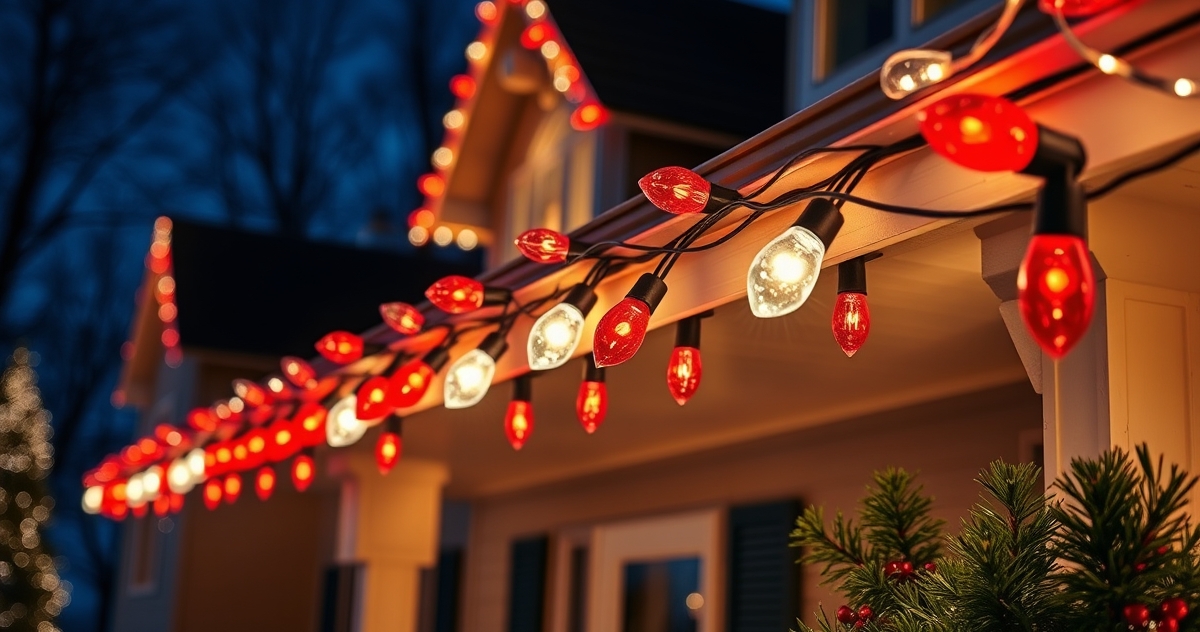
The single biggest variable in any Delaware lighting budget is the choice between LED and traditional incandescent products. LED C9 bulbs — the large, classic globe-style bulbs used on rooflines and along gutters — now dominate the professional market for good reason. A 25-foot run of commercial-grade LED C9 bulbs in warm white typically draws about 12–15 watts, compared to 175 watts or more for the same run in incandescent C9s. At Delaware's average residential electricity rate of approximately 13.5 cents per kWh, that difference adds up to real savings over a six-week display season.
LED net lights are another product worth budgeting specifically. They're the most efficient way to cover shrubs and hedges uniformly, and a single 4×6-foot LED net light panel can replace dozens of individually strung mini lights. For a mid-size Delaware home with foundation plantings, budgeting for four to eight net light panels is a reasonable starting point.
Hardware: Clips, Controllers, and Timers
Roofline clips are a line item many first-time clients overlook. Professional-grade all-in-one roofline clips — designed to hold C9 light strands securely through Delaware's December wind and ice events — run roughly $0.15–$0.30 per clip, and a typical Delaware colonial or cape cod may require 150 to 300 clips depending on roofline length. Budget this separately from bulbs and wire.
Timer controllers are one of the highest-return investments in any lighting budget. A quality programmable timer controller eliminates the need to manually switch displays on and off, ensures your lights run during the most visible evening hours, and reduces unnecessary electricity consumption during daylight. For most Delaware homes, one or two outdoor-rated digital timer controllers — budgeted at $25–$75 each depending on channel capacity — handle the entire display efficiently.
The 10–15% Contingency Rule
Delaware professional installers consistently recommend adding 10–15% to your initial estimate as a contingency buffer. Historic New Castle County neighborhoods — including parts of Old New Castle, Newark, and Wilmington — are full of Victorian, Federal, and Colonial Revival homes with complex rooflines, multiple dormers, bay windows, and decorative cornices. Each of these features requires extra product, custom clip configurations, and additional labor time. Even a seemingly straightforward Rehoboth Beach cottage may have wraparound porch railings, outdoor shower structures, or second-story balconies that add scope. Building that buffer into your summer budget means you won't be cutting corners on the job site in November.
Explore the full scope of what a professional installation covers by visiting our residential holiday lighting services page.
Delaware Home Styles and How They Shape Your Lighting Plan
Delaware's architectural variety directly determines how much product you need and what installation approach works best — and no two properties are identical. A single-story Rehoboth Beach bungalow with a shallow-pitch roof and cedar shake siding calls for a completely different plan than a three-story Wilmington rowhouse with a flat parapet and brick facade.
Coastal Properties: Lewes, Rehoboth, Dewey, and Bethany
Coastal Delaware homes require products rated for salt air and higher wind loads. Warm white or cool white LED C9 bulbs give beach cottages a clean, elegant look that complements natural wood tones and weathered finishes. LED net lights in multicolor are popular for low beach hedges and ornamental grasses. Because coastal installations are often more exposed, investing in commercial-grade clips and UV-stabilized wire pays off across multiple seasons.
Historic New Castle County and Wilmington Rowhouses
Wilmington rowhouses and historic properties in Old New Castle present unique challenges: shared walls, party parapets, and ornate cornices mean roofline access may require specialized ladders or lift equipment. Lighting plans here often lean heavily on door and window framing with garlands, wreaths, and bows, supplemented by warm white C9 roofline accents where access allows. Budgeting for custom garland lengths and coordinated bows adds to cost but dramatically improves curb appeal on these architecturally rich facades.
Suburban Delaware: Newark, Dover, and Middletown
Suburban colonials and split-levels across New Castle and Kent Counties typically offer the most straightforward roofline access and the most predictable product quantities. A standard two-car-garage colonial in Newark or Middletown might budget for 200–300 feet of roofline C9 string, LED net lights for front foundation shrubs, wreath and bow accents for windows, and a single timer controller. Multicolor displays remain popular in family neighborhoods, while warm white is trending strongly among homeowners seeking a more refined aesthetic.
For commercial properties and business districts across Delaware, our commercial holiday lighting services include scaled budgeting and dedicated account management.
Energy Costs and Electricity Savings: Running the Numbers for Delaware
Delaware homeowners can calculate their expected display electricity cost with a straightforward formula, and doing it in summer allows meaningful product comparisons before any money changes hands.
| Product Type | Wattage per 25-ft Run | Hours/Day | Days Active | Est. Season Cost (@ $0.135/kWh) |
|---|---|---|---|---|
| Incandescent C9 Bulbs | 175W | 6 | 42 | ~$5.93 per run |
| LED C9 Bulbs (warm white) | 14W | 6 | 42 | ~$0.47 per run |
| LED Net Lights (4×6 panel) | 8W | 6 | 42 | ~$0.27 per panel |
| Incandescent Mini Lights (100-ct) | 40W | 6 | 42 | ~$1.36 per strand |
For a full Delaware home display using twelve 25-foot runs of roofline C9 lighting, the seasonal electricity difference between incandescent and LED C9 bulbs alone is roughly $65–$70. Multiply that across multiple display zones and add net lights and tree wrapping, and the LED upgrade can pay for itself within two to three seasons — without factoring in the longer LED lifespan, which typically reaches 25,000–50,000 hours versus 1,000–2,500 hours for incandescent.
Timer controllers compound those savings. A display running on a smart timer rather than left on overnight can reduce runtime by 30–40%, further lowering your seasonal electricity bill.
Product Availability and Manufacturer Warranties: Why October Is Too Late
Nationwide holiday lighting inventory shortages are a documented annual pattern. By early October, the most popular SKUs — commercial-grade warm white LED C9 bulbs, specific roofline clip styles, and premium net lights — begin selling out at distributors across the country. Delaware installers who don't pre-order in summer are left choosing from whatever remains, which often means substituting products that don't match the original design vision or accepting longer lead times that push installation dates into late November.
Manufacturer warranties are another summer-planning advantage. Most commercial-grade LED products carry two- to five-year warranties, but warranty registration and documentation requires purchase records tied to specific installation dates. Planning in summer gives your installer time to properly document products, register warranties, and flag any defective units before they're mounted 20 feet off the ground in December.
For homeowners interested in displays that last year-round without seasonal reinstallation, our permanent holiday lighting solutions offer a budget-friendly alternative over a three-to-five-year horizon.
Post-Season Costs: Removal and Storage in Your Delaware Budget
A complete holiday lighting budget doesn't end at installation — removal and storage are recurring costs that Delaware homeowners should plan for every year. Professional takedown services protect commercial-grade products from winter storage damage, ensure clips and hardware are inventoried for reuse, and prevent the kind of DIY removal that breaks strands or bends clips beyond reuse.
Budgeting $150–$400 for professional removal and storage on a standard Delaware residential property is typical, depending on display size and complexity. Homeowners who bundle installation, removal, and storage into a single seasonal contract frequently receive preferred pricing and guaranteed availability for the following year — a strong argument for establishing that relationship in summer rather than waiting until the season ends.
Learn more about how our team handles end-of-season care at our removal and storage services page, or explore our complete holiday lighting services for a full overview of what we offer across Delaware.
Frequently Asked Questions
When is the best time to book holiday lighting installation in Delaware?
The best time to book holiday lighting installation in Delaware is June or July. Installers have open calendars during summer, early-booking pricing is available, and product inventory is fully stocked before nationwide shortages begin in October. Homeowners who book in summer consistently get preferred installation dates in November and avoid the rushed scheduling that defines peak season from late September onward.
How much does professional holiday lighting cost for a Delaware home?
Professional holiday lighting installation in Delaware typically ranges from $500 to $3,000 or more for residential properties, depending on home size, roofline complexity, number of display zones, and product selection. A standard suburban colonial in Newark or Middletown with LED C9 roofline lighting, net lights on foundation shrubs, and wreath accents commonly falls in the $800–$1,500 range. Historic properties with complex architecture or large coastal homes may exceed $2,500. Always budget an additional 10–15% above your initial estimate for unforeseen complexity.
Are LED C9 bulbs worth the extra upfront cost compared to incandescent?
Yes — LED C9 bulbs are worth the higher upfront cost for most Delaware homeowners. LED C9s draw roughly 14 watts per 25-foot run compared to 175 watts for incandescent equivalents, translating to electricity savings of more than 90% per run per season. At Delaware's average residential electricity rate of approximately 13.5 cents per kWh, a 12-run roofline display saves roughly $65–$70 per season on electricity alone. Combined with LED lifespans of 25,000–50,000 hours versus 1,000–2,500 hours for incandescent, the upgrade typically pays for itself within two to three seasons.
What light colors work best for Delaware coastal homes?
Warm white and cool white LED C9 bulbs are the most popular choices for Delaware coastal homes in communities like Rehoboth Beach, Lewes, and Bethany Beach. Warm white complements natural wood tones and weathered cedar shakes, while cool white creates a crisp, nautical aesthetic that suits beach architecture. Multicolor LED net lights are popular for low shrubs and ornamental plantings in coastal front yards. All coastal products should be rated for salt air and wind exposure to ensure multi-season durability.
Can I use a timer controller with professional holiday lighting?
Yes — professional-grade timer controllers are compatible with all commercial holiday lighting systems and are strongly recommended by Delaware installers. A programmable outdoor timer controller lets you set exact on/off times so your display runs during peak evening viewing hours and shuts off automatically overnight, reducing electricity consumption by 30–40%. Most Delaware residential displays require only one or two timer controllers, typically priced between $25 and $75 each, making them one of the highest-return items in your holiday lighting budget.
Does Holiday Lights Decor Delaware serve municipal and commercial clients?
Yes — Holiday Lights Decor Delaware provides professional holiday lighting installations for municipal, commercial, and residential clients across the state. Municipal projects — including town center displays, park lighting, and public building decorations — require scaled planning, permitting coordination, and commercial-grade products suited for high-visibility, high-traffic environments. Commercial clients including retail centers, restaurants, and office parks across Delaware benefit from dedicated account management and flexible installation scheduling. Visit our municipal holiday lighting page or commercial services page for more information.
Ready to lock in your summer pricing and build a holiday lighting plan tailored to your Delaware home or business? Contact Holiday Lights Decor Delaware today for a free estimate — our team is ready to help you design a display that fits your budget, your architecture, and your vision, with none of the October scramble.